

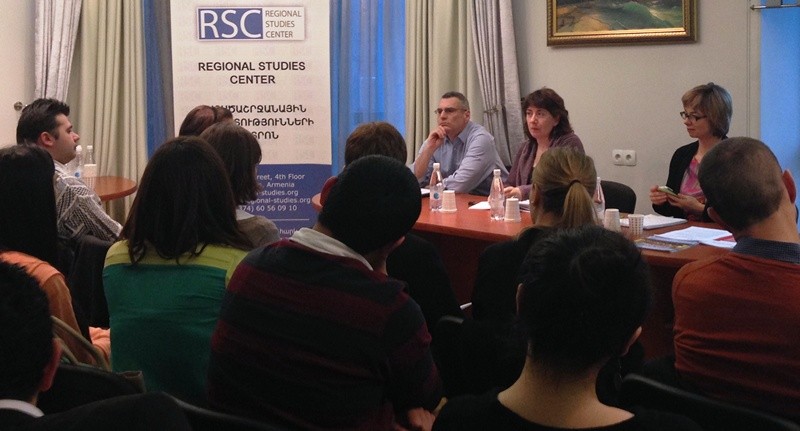
The Regional Studies Center (RSC) convened a special “focus group” discussion on February 17 focusing on the outlook for Armenia-EU relations, including an assessment of the implications from the Armenian president’s controversial September 2013 decision to forego the long-planned initialing of an Association Agreement with the EU. The focus group discussion was organized as part of the research project EUIMPACTEAST (France/UK) entitled, “Exploring the EU's influence on Domestic Change in Eastern Partnership Countries” (for more information on the project, please go to: www.euimpacteast.org).
.RSC Director Richard Giragosian opened the event, and explained that as the latest in a series of regular focus group sessions conducted by the RSC, participants were “encouraged to be as open and dynamic as possible,” adding that “there are no right or wrong answers, because all ideas and comments are important.” He went on to clarify that “the purpose of a focus group is to solicit new ideas and honest thoughts regarding specific topics of themes, with this focus group tasked with brainstorming over the future of Armenia’s relationship with the European Union (EU).”
The two members of the RSC team helping to facilitate the field research, Satenik Baghdasaryan and Rima Kharatyan, then introduced the project’s two Principal Investigators, Dr. Laure Delcour, a Senior Research Fellow at the Institute of International and Strategic Relations (IRIS) in Paris, and Dr. Kataryna Wolczuk, the Deputy Director of the Centre for Russian and East European Studies at the University of Birmingham in the UK.
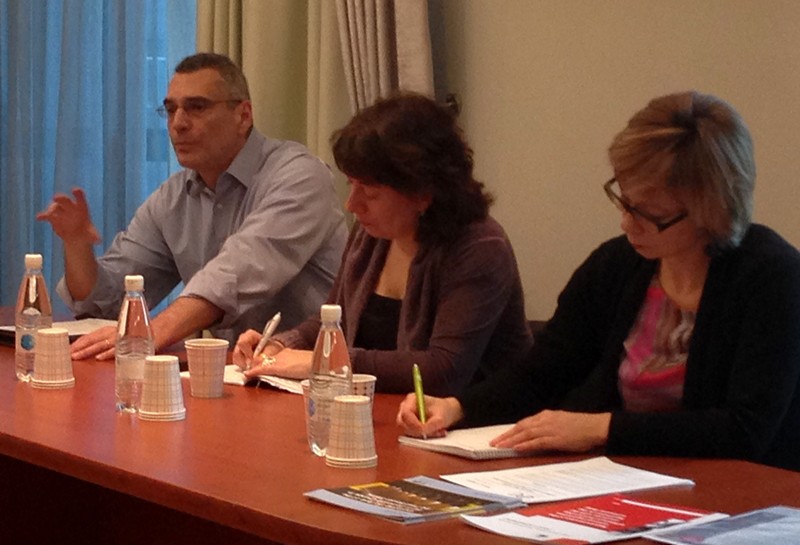
Participants in the focus group covered a wide range of issues, with a focus on the state of negotiations and legal approximation with EU demands in the sectors of energy, visa liberalization, competition and food safety, among others. The discussion also centered on the role of the European Union (EU) in terms of domestic change within the Eastern Neighborhood, especially in light of an increased role and greater engagement in the region, expressed through the Eastern Partnership (EaP) program.
Two other keys issues included the process of these countries’ alignment with EU rules, norms and standards (the so-called “acquis”) and the broader question of prospective EU membership. The focus group then closed with a detailed assessment of the EU’s role as a “transformative power” beyond the context of enlargement.
The focus group participants included graduate students from YerevanStateUniversity’s Centre for European Studies (CES), local staff from the OSCE Office in Armenia, the EU Advisory Group, the United Nations, the Embassy of Poland, and representatives from several civil society organizations. Several guests also attended the focus group as observers, including Lithuanian Ambassador to Armenia Erikas Petrikas and officials from the EU Delegation to Armenia and the Embassy of France.